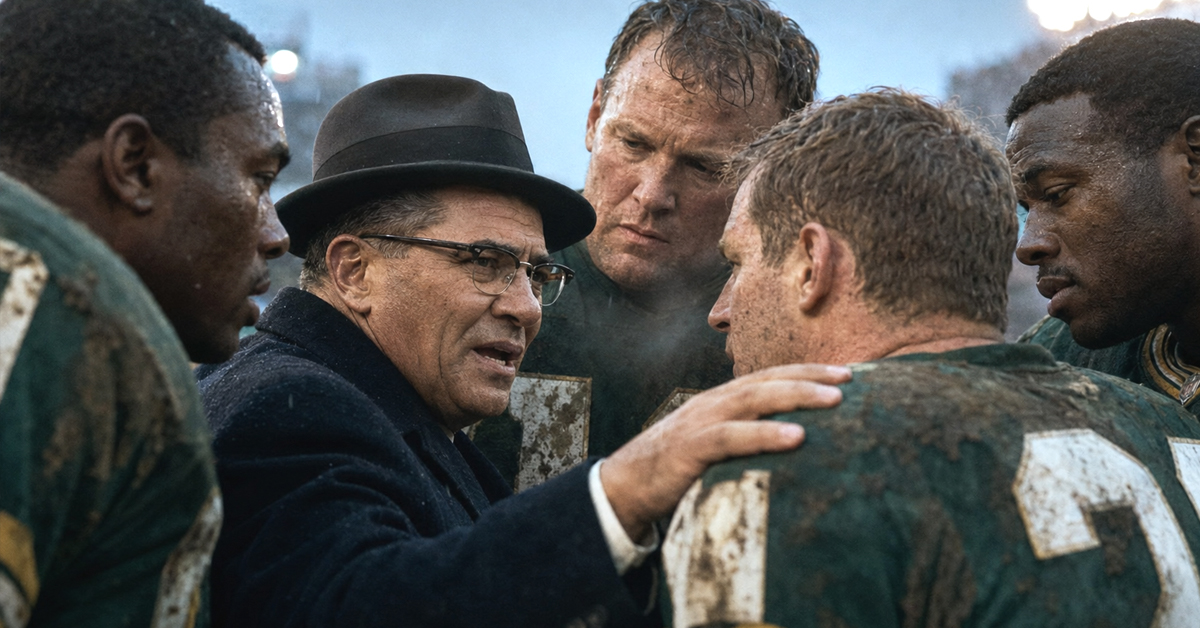
Behind the shouting, the championships, and football’s most famous misquotation was a deeply Catholic vision of discipline, dignity, and character in action.
Apparently, We Were Packers Fans
When I was five years old, my dad gave my younger brother and I Green Bay Packers uniforms—the helmet, the colors, the whole small-boy version of Sunday afternoon glory. A lamp made from a Packers football helmet sat proudly on our dresser.
This was a little unusual.
I grew up in South Bend, Indiana, where football loyalties tend to begin and end with Notre Dame. My mother graduated from St. Mary’s College, and my father graduated from Notre Dame. Dad also grew up on the South Side of Chicago, which did not make Green Bay the obvious choice for our household.
The explanation emerged years later.
Both of my parents had known Paul Hornung during his time at Notre Dame. I still have a photograph of my mother riding on his shoulders during a rally march across the Notre Dame quad.
The first time I met Hornung, he spotted my father across the room and asked if that was my dad. When I said yes, Paul informed me that he had helped Dad with his studies at Notre Dame.
My father laughed when I repeated the story. According to him, it had worked the other way around: Dad was the one who helped Paul through his classes.
I am not going to referee that contest now. One of the men became a Hall of Fame football player. The other was my father who was a highly accomplished business professional… and besides, fathers generally remain undefeated in family history.
What I eventually understood was that my parents knew Hornung, and my father respected him deeply. Dad also admired great coaches—men such as Knute Rockne and Frank Leahy, who formed players as well as winning teams. Vince Lombardi was an extension of that tradition: demanding, disciplined, and convinced that coaching was ultimately about building character.
Apparently, we had been Packers fans all along.
I was simply the last one to find out.
The Man Behind the Mythology
Like most people, I first knew Lombardi through the mythology: the championships, the sideline intensity, the famous quotations, and the trophy bearing his name.
Vince Lombardi has been dead for more than half a century, and he is still yelling at us—from grainy sideline footage, framed office posters, and motivational speeches delivered by people who have never had to run a power sweep in Green Bay in December.
Hovering over the legend is the line everyone knows:
“Winning isn’t everything; it’s the only thing.”
The phrase did not originate with Lombardi, and the meaning usually attached to it does not do justice to the man.
He was fiercely competitive. He could be volcanic, exhausting, demanding, and hard on the people closest to him. Winning mattered enormously. But beneath that intensity was something deeper than a hunger for trophies. His understanding of excellence, discipline, teamwork, and human dignity was formed by a Roman Catholic faith he practiced throughout his life.
The trophy was visible. The formation behind it was not.
Before the Packers, There Was the Church
Lombardi grew up in a Catholic Italian American family in Brooklyn. He served as an altar boy and, for a time, believed he might become a priest. He attended Cathedral College of the Immaculate Conception, a preparatory seminary, before recognizing that his vocation lay elsewhere.
Football helped him find it.
At Fordham University, Lombardi played on the line that became famous as the “Seven Blocks of Granite.” But Fordham gave him more than toughness and a memorable nickname. Its Jesuit education supplied the intellectual structure through which he would understand freedom, responsibility, community, and character.
One course was especially important. In an ethics class taught by Father Ignatius Cox, S.J., Lombardi encountered the idea that freedom was not the absence of restraint or the ability to do whatever one pleased. Real freedom required the will to be ordered toward the good—the individual choosing to discipline himself and join others in pursuit of a common purpose.
Father Cox described the will as “character in action.”
That phrase could have been written across Lombardi’s entire coaching career.
Lombardi’s faith was not merely a Catholic childhood he remembered fondly after becoming famous. He attended Mass regularly—often daily—and prayed the Rosary. Long before practice plans, game film, reporters, and the pressure of Sunday afternoon, he placed himself before God.
That rhythm matters. It reveals the order he believed life should have, even when he did not always live that order perfectly: God first, then the responsibilities God had given him.
Football was not his religion. It was his vocation.
Discipline Was Supposed to Produce Freedom
The most famous play of Lombardi’s Packers was not exotic. It was the power sweep. Everyone knew it was coming. Opposing coaches studied it. Defenders prepared for it. Lombardi ran it anyway.
His players practiced its footwork, timing, blocks, reads, and angles until the movements became instinctive. This was not repetition for repetition’s sake. Lombardi understood that disciplined preparation created freedom under pressure.
When the play unfolded, the runner did not robotically follow a line painted on the turf. He was taught to “run to daylight”—to recognize the opening and move decisively through it. Practice had trained the player to see clearly and respond freely when the field became chaotic.
That’s the discipline developed in The Discipline Challenge. Discipline is not the enemy of freedom. Properly ordered, it makes freedom possible. It trains us to act according to what we value instead of becoming captive to panic, fatigue, appetite, or the emotion of the moment.
The disciplined musician can improvise because the scales have become second nature. The disciplined craftsman can adapt because the fundamentals are secure. The disciplined Christian can respond with patience or courage because virtue has been practiced before the crisis arrives.
Lombardi did not want players who could merely follow instructions in practice. He wanted men capable of making the right decision when the play broke open and no coach could make it for them.
Preparation formed perception. Perception made decisive action possible.
Focus: Do the Ordinary Thing Exceptionally Well
Modern culture is fascinated by novelty. New systems. New hacks. New language for old problems. We are easily persuaded that transformation must begin with something dramatic.
Lombardi built a dynasty by returning relentlessly to fundamentals.
On the first day of training camp, according to the familiar story, he held up a ball and began: “Gentlemen, this is a football.” Whether every retelling preserves the moment precisely is less important than why the story endured. It captured his method.
Lombardi stripped away excuses and clutter. Block. Tackle. Protect the ball. Know your assignment. Execute the play. Do the ordinary thing so well that it becomes very difficult to stop.
This is The Focus Effect applied to a football field. Focus is not simply concentration. It is the ability to identify what deserves attention and refuse to let lesser things displace it.
Most of us do not fail because the fundamentals are hidden from us. We fail because they are familiar enough to become boring.
We want the new insight when the old responsibility is still waiting. We want a breakthrough when what we may need is another honest repetition. We want purpose while ignoring the small duties through which purpose becomes visible.
Lombardi understood that excellence is usually constructed from unglamorous things performed with unusual care.
The Person Inside the Uniform
Lombardi demanded the same standards from every player, but that did not mean he treated players as interchangeable machinery.
He was an Italian American who had experienced ethnic prejudice and believed discrimination had delayed his opportunity to become a head coach. In Green Bay, he made it clear that racial discrimination against his players would not be tolerated. When Black Packers were refused service by local establishments, Lombardi was prepared to have the entire team boycott them. During trips to the segregated South, he found arrangements that allowed the team to remain together.
His protection extended beyond race. Years before professional sports was prepared to speak openly about homosexuality, Lombardi warned members of his Washington coaching staff that mistreatment of gay players would bring immediate consequences. His brother Harold was gay; Lombardi understood that prejudice did not remain an abstract social issue when it entered the life of someone you loved.
Lombardi was not using the fashionable vocabulary of a later era. His response grew from older soil: the dignity of the human person, the demands of justice, and the responsibility of each person to the common good.
He judged football ability relentlessly. But he would not allow a player’s race, ethnicity, or private vulnerability to cancel his human dignity.
This is where The Emotional Intelligence Edge becomes more than learning to manage a bad mood. Emotional intelligence at its best allows us to see the whole person rather than reducing someone to a category, a weakness, a usefulness, or an inconvenience. It joins clarity with empathy and authority with responsibility.
When asked what enabled his Packers to withstand the pressure of a punishing championship finish, Lombardi did not point first to conditioning, strategy, or fear of the head coach.
“Because they love each other,” he said. “There is a great deal of mutual respect by every man on this team.”
That does not sound much like the cartoon version of Lombardi.
It sounds like a man who understood that sacrifice becomes possible when people know they do not stand alone.
Perseverance Before Glory
Lombardi did not become an NFL head coach until he was 45. By then he had spent more than two decades teaching and coaching at the high school, college, military, and professional levels.
He taught Latin, chemistry, and physics at St. Cecilia High School in New Jersey. He coached basketball as well as football. He served as an assistant at Fordham, Army, and with the New York Giants. He watched younger and less experienced men receive opportunities he believed he had earned.
The Lombardi story looks inevitable only when told backward.
Living it required The Perseverance Test. He continued preparing through years when there was no assurance that the position he wanted would ever arrive. When Green Bay finally called in 1959, the Packers were coming off a 1–10–1 season. Lombardi inherited not a dynasty, but a demoralized organization with a habit of losing.
The team went 7–5 in his first season. The following year it reached the NFL Championship Game and lost.
That defeat became material, not a verdict. The Packers went on to win five NFL championships in seven seasons, including the first two Super Bowls.
Failure told Lombardi what still needed to be formed.
Then the work resumed.
Adaptability Beneath the Certainty
Lombardi projected absolute conviction, but he was capable of changing.
Early in his years with the New York Giants, his relentless barking alienated veteran players. Eventually he approached Frank Gifford and Charlie Conerly and asked a question that insecure leaders avoid:
What am I doing wrong?
They told him. Lombardi adjusted, built trust, and became a far more effective coach.
That moment belongs squarely within The Adaptability Advantage and The Growth Mindset. Confidence is not the refusal to reconsider. Sometimes confidence is what makes reconsideration possible. A rigid ego protects its methods. A purposeful leader protects the mission—and will change his methods when they are undermining it.
Lombardi’s willingness to listen did not make him less demanding. It made his demands more effective because he learned that leadership required relationship, not merely volume.
The Uncomfortable Part of This Waypoint
It would be easy to end here and polish Lombardi into a Catholic motivational poster.
That would miss an important part of his life.
The same intensity that produced excellence also consumed him. Football strained his marriage and complicated his relationships with his children. The pressure he carried damaged his health. His discipline could become severity; his pursuit of excellence could become obsession. A man who preached order did not always keep his own loves perfectly ordered.
This does not nullify his faith. It demonstrates why faith is formation rather than image management.
Lombardi went to Mass because he was Catholic, not because he had achieved spiritual flawlessness. He needed grace as much as the men he coached. His life reminds us that strengths do not automatically remain virtues. Discipline without emotional balance can become harshness. Perseverance without discernment can become compulsion. Purpose without proper order can devour the very people it was meant to serve.
The Lectio Vitae mindsets are designed to work together for precisely this reason.
Focus helps little if we focus on the wrong thing. Discipline can make us efficient without making us good. Perseverance can keep us traveling in a direction we should abandon. Emotional intelligence can expose the human costs our ambition prefers not to count. Purpose asks the final, governing question: What is all this effort for?
Lombardi’s greatness and his limitations both belong in the answer.
Character in Action
Late in life, Lombardi reportedly regretted the way his famous winning quotation had been used. His fuller conviction was not that the scoreboard could justify anything. It was that a person wins in a deeper sense when he gives everything honestly and completely to the task before him.
That is not a guarantee of victory.
It is a standard of faithfulness.
Lombardi believed teaching and coaching meant more than transmitting information. A teacher, he said, had to give of himself, build character, and help another person become better. That may explain why receiving Fordham’s Insignis Medal as a teacher—not merely being celebrated as a championship coach—became one of his proudest moments.
The world remembers the trophies. Lombardi appears to have understood that the people were the real work.
His Catholic faith gave him a language for that work: will, sacrifice, duty, dignity, community, love, and the common good. Football gave him a field on which to practice it—brilliantly at times, imperfectly at others.
The same is true for us. Our faith is not meant to hover above our work, family, habits, and decisions as a respectable private belief. It is meant to enter them, order them, challenge them, and change how we act when the pressure rises.
Because character is not what we admire.
Character is what takes the field.